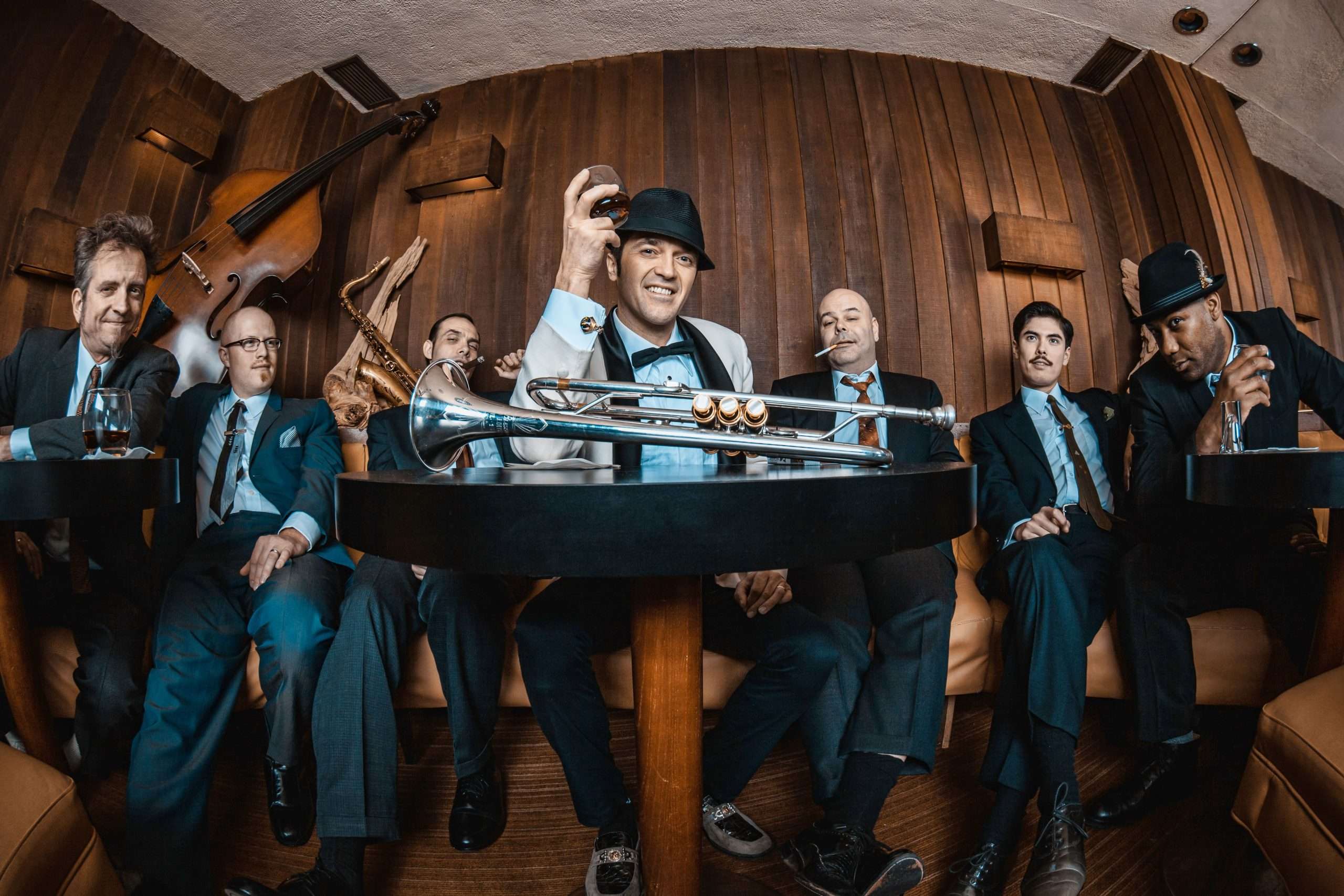

Emerging from the vibrant 1980s ska/punk scene, the Cherry Poppin’ Daddies quickly became known for their unique fusion of swing and other pre-rock musical styles, firmly establishing their place in the national spotlight with their 1997 album, “Zoot Suit Riot,” featuring the Top 40 hit title track. Still fronted by singer-songwriter Steve Perry, the Oregon-based, horn-driven band continues to captivate audiences with its distinctive sound and sharp, thought-provoking lyrics. Their latest endeavor, “WWII Tiki Xmas Canteen,” is a nostalgic holiday production that channels the spirit and charm of a 1940s radio broadcast.
Purchase the “Daddies’” latest album, “At The Pink Rat,” online at daddies.com.
Join us for an unforgettable night at the Allied Solutions Center for Performing Arts. Get your tickets at thecenterpresents.org.

Janelle Morrison: I love that you and the band are coming out to Carmel, Indiana! I always say that I was born in the wrong era. I enjoyed the revival of swing in the ’90s and hope to see everyone up from their seats, dancing throughout your concert! Let’s take a step back and look at the evolution of the “Daddies” over the last few decades.
Steve Perry: We started [as a band] back in November of 1988… that was a long time ago! And really, 1989 was our first full big year. I had been in punk rock bands and was looking for something that was different… a different way to express myself through the DYI kind of ethos that was punk rock. I didn’t want to sound like everybody else. I was very interested in the swing genre—my mother used to bake bread on Sundays, and we would sit and watch old black-and-white movies from the ’30s and ’40s. I guess I kind of got a real taste for that era, and at some point, I just decided to try to combine my punk rock energy and aggression with this swing thing. So, I started experimenting to see if I could create a hybrid sound.
JM: It appears that it worked out well for you.
SP: We started experimenting, writing songs and had our first shows. We also played ska, punk rock and funk, but because we had this ripping horn section, I remember, people really responded well to that part of our set. People would ask, “What do you call that music?” That’s how far gone from reality [swing] was.
We widened our sphere of influence and met a few bands that did similar things to us… there were far more ska bands than there were swing bands, but it grew over the [’90s] and then exploded in 1998. There was an openness to different types of music in the ’90s… there were a lot of weird bands playing weird music that I don’t think could have happened at any other time. The Cold War had ended, and it was a bright, hopeful and fun time, comparatively, even from the early ’90s. It was a brief celebratory period before 2001. Looking back, it was nice to soften the edges of the punk rock energy, though I always try to keep the lyrical content serious and interesting… like little novelettes, but within the rubric of the fun dancing.

JM: What have you been doing since the big hit, “Zoot Suit Riot,” leading up to 2024 and the release of your latest album, “At The Pink Rat?”
SP: After “Zoot Suit Riot,” the world wasn’t going to accept the sight of us anymore because “it” was over. As I said earlier, we had been more ska and punk rock and had this other side to us, and we concentrated on more of the ska stuff and branched out, playing whatever I was feeling at the time. We continued to play, and I continued to write, and I went back to school around 2002 and got my degree in molecular biology. We kept on doing our thing, and we’d make a swing album and then a mix album with different genres. We’ve always played the swing that we’re most known for, but we don’t do it 24/7.
We made this record, “At The Pink Rat,” and now I’m working on some ska stuff… I’ve recorded ten songs for this upcoming record due out in 2025.

JM: Can you share with me the backstory for your upcoming show at the Palladium?
SP: We developed the WWII Tiki Xmas Canteen show at Pearl Harbor for Pearl Harbor Day in Honolulu. The night before [the attack] Pearl Harbor, all the ships had a big band contest, and we did that the night before National Pearl Harbor Remembrance Day. The idea was to try to mimic some of the hits that they might have been playing at that time and throw in some of our own material. So, this show is most of our material with some Christmas songs… like it’s the holidays in the 1940s, in the South Pacific.
It’s an appreciation for some of the music that we don’t hear that often and for American traditional music. Jazz is one American invention of music that is heard throughout the world. This show is in part a tribute to the “Greatest Generation.” I think we’re sort of haunted by the spirits of that era. Through this show, I am interested in examining what that generation means to us now while also paying homage.